I. THE SHOCK THAT SPLIT A MOVEMENT IN HALF
The day Charlie Kirk died, a soundless shockwave moved through his movement — the kind that rewrites alliances, bends narratives, and leaves ordinary supporters grasping for clarity.
Grief came first.
Confusion came second.
Speculation came third — and refused to leave.
It wasn’t because anyone suspected foul play. There was no official suggestion of crime, conspiracy, or hidden perpetrator. It was because the circumstances surrounding Charlie’s final months didn’t feel settled to the people who had followed his rise for years.
He wasn’t just a political figure; he was the gravitational center of a sprawling, high-energy universe. Conferences. Donors. Media tours. Youth summits. The man lived in motion.
And then suddenly: silence.
Charlie’s legacy became Erika’s burden overnight. From widow to leader, from partner to figurehead, her life was rearranged by tragedy — but also by expectation, responsibility, and scrutiny beyond imagination.
Few people saw the pressure building under the surface.
Even fewer understood what was coming next.
II. ENTER ROGAN AND OWENS — THE TORCHBEARERS OF UNCOMFORTABLE QUESTIONS
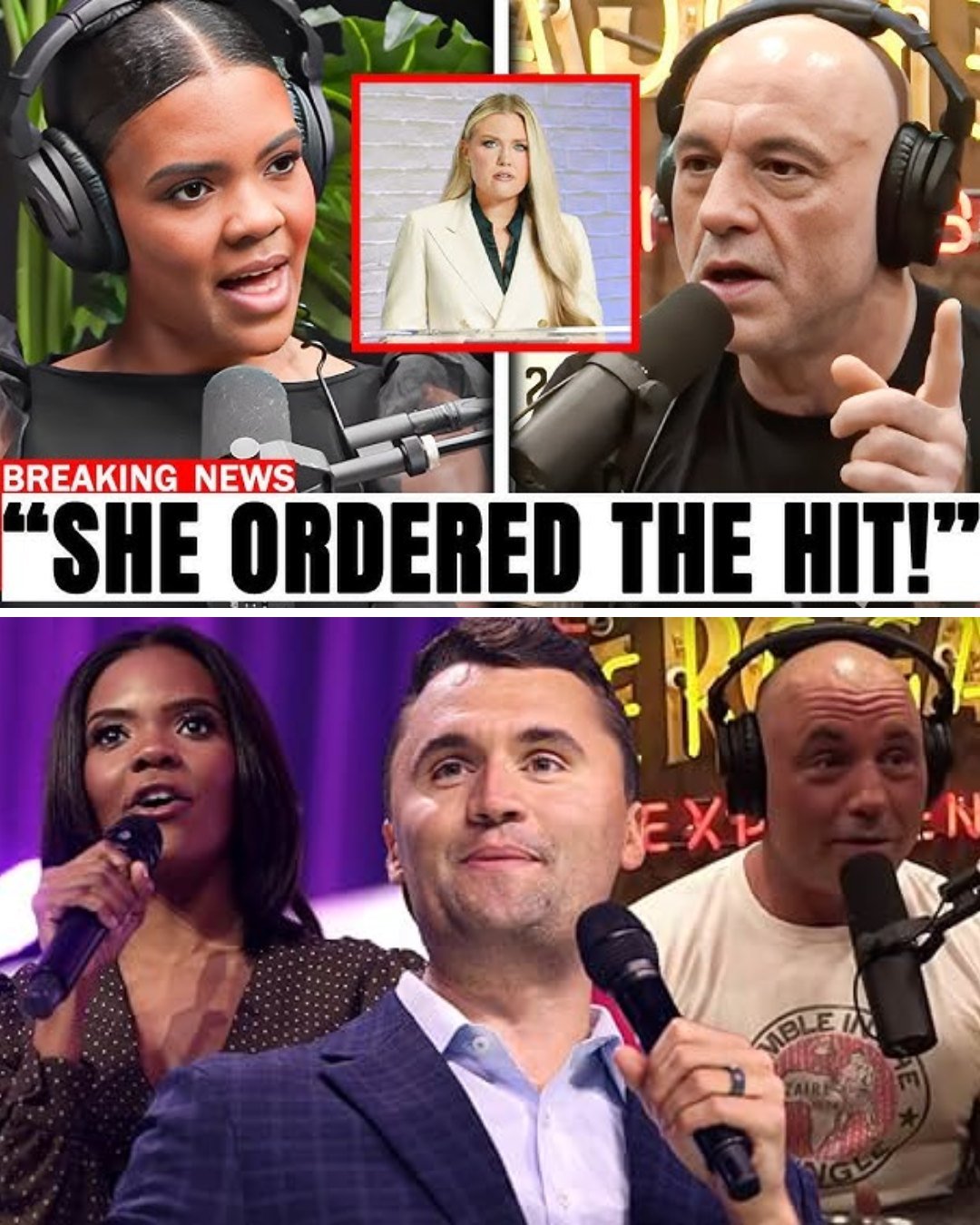
When Joe Rogan leaned forward in his chair, fists resting on his knees, audiences across America felt it. That signal — the universal Rogan tic — meant a conversation was about to shift into darker, deeper territory.
Candace Owens was sitting across from him, posture taut, eyes sharp, her voice walking the razor’s edge between grief, skepticism, and the fierce protectiveness of a friend left behind.
They weren’t accusing anyone of anything.
They weren’t alleging crimes.
They were doing something more subtle — and far more explosive:
They were questioning the narrative vacuum.
Rogan said it plainly:
“Something feels… unresolved. When people lose someone suddenly, there’s usually chaos. But this feels like everyone jumped straight to ‘moving on.’ And that’s weird.”
Owens didn’t argue.
“There are gaps,” she said quietly.
“Not because anyone did something wrong — just because no one is explaining anything.”
And that was the spark.
The internet didn’t need allegations.
It only needed questions.
III. THE ANOMALIES THAT STARTED THE WAVE
Every major tragedy leaves behind inconsistencies — not because of conspiracies, but because real life is messy, uncoordinated, and emotionally chaotic. Still, the vulnerabilities in Charlie’s final months stood out to many observers:
1. Security at the event
Not a breach.
Not negligence.
Just… confusion.
Multiple agencies, contractors, and staffers had overlapping responsibilities. The kind of disorganization that happens when an organization grows too fast — and suddenly finds itself responsible for the kind of event scale usually handled by governments.
2. Missing footage
Not deleted.
Not suspicious.
Just unarchived due to technical issues, server transitions, and incomplete backups — the kind of boring IT failure that becomes dramatic when grief magnifies everything.
3. Leadership shifts
In the final months of Charlie’s life, several insiders reported that Erika had been taking on more strategic leadership roles — not secretly, not controversially, but naturally, as Charlie’s workload grew punishingly intense.
He trusted her.
He relied on her.
She stepped in.
But after his death, that routine transition suddenly looked, to outsiders, like a foreshadowing.
And in politics, timing always breeds suspicion — even when nothing improper occurred.
IV. TEXTS, PRESSURES, AND THE UNANSWERED THREADS
After the Rogan–Owens conversation went viral, several “insider accounts” leaked online. None of them made accusations. None provided evidence of wrongdoing. They simply offered emotional snapshots of a chaotic, high-stakes operation:
Donor demands
Internal disagreements about strategy
Staff overwhelmed by rapid growth
Charlie’s exhaustion after years of nonstop travel
Executive decisions shifted to Erika simply because she was the only person Charlie trusted fully
Every piece of “leaked info” painted the same truth:
The organization was under enormous pressure long before tragedy struck — and everyone was dealing with it differently.
Rogan summarized it best:
“People want everything to make sense. But grief never makes sense. Leadership transitions don’t make sense. Human beings don’t make sense.”
Yet people kept digging anyway.
Because unanswered questions aren’t resolved by logic.
They are resolved by story — and no one had provided a story yet.
V. ERIKA’S POSITION: POWER, GRIEF, AND AN UNWANTED SPOTLIGHT
There are widows who disappear.
There are widows who fight.
And there are widows who inherit empires they never asked for.
Erika fell into the third category.
She didn’t choose to become the face of a movement worth tens of millions.
She didn’t choose to become the stabilizing voice for millions of followers.
She didn’t choose to become the center of a nation’s speculation.
But responsibility doesn’t ask for permission.
From the moment she stepped into the role, she carried three identities simultaneously:
The grieving wife
The unexpected leader
The reluctant public figure
That triple weight is almost impossible to hold without something cracking.
Some online commenters interpreted her calmness as coldness.
Others saw her composure as strength.
But public perception has never been kind to widows — especially widows of powerful men.
As Candace Owens put it:
“No one knows how grief should look. No one has the right to decide how she should mourn.”
But that didn’t stop the speculation.
Nor did it stop the emotional tremors moving through the movement’s base.
VI. THE DUALITY OF CHARLIE’S FINAL YEAR
Supporters liked to imagine Charlie as unstoppable — a hurricane in human form. But those close to him saw the toll of maintaining a national brand:
constant travel
media appearances
organizational disputes
ideological battles
the weight of being a symbol
the exhaustion that accumulates when you’re always “on”
He was chasing impact.
He was chasing momentum.
And sometimes, he was chasing peace in the only way public figures know how:
by working harder than the pain.
Several insiders describe that final year as:
“A race where he never stopped to breathe.”
This wasn’t scandal.
This wasn’t conspiracy.
This was a man burning at both ends — supported by a wife who tried to carry the parts he couldn’t.
But it’s difficult to explain complexity to a grieving audience.
It’s easier for the public to fill silence with narratives.
And that’s how confusion becomes controversy.
VII. THE MEDIA MACHINE TAKES OVER
Rogan and Owens weren’t trying to create a scandal.
But they did something even more powerful:
They opened a door.
And the media — both mainstream and underground — walked through it with torches.
Headlines shifted from:
“Remembering Charlie Kirk”
to
“Inside Charlie’s Final Days”
to
“Unanswered Questions Raise New Debates”
Not because there was wrongdoing.
But because ambiguity sells.
Mystery captivates.
Contradiction magnetizes.
Audiences don’t want facts.
They want tension.
And this story had tension in abundance.
VIII. WHY THE OFFICIAL STORY FEELS INCOMPLETE (EVEN IF IT’S TRUE)
Humans are pattern-seeking creatures.
We believe tragedies should have warnings, signs, premonitions — something that makes the end feel earned.
But Charlie’s story had none of that.
No obvious decline.
No foreshadowing.
No dramatic fall.
Just: here one day, gone the next.
This is why the public clings to anomalies:
a missing video archive
an unclear chain of command
a widow who steps into leadership immediately
staffers speaking cautiously
friends giving half-hints of internal stress
None of these imply guilt.
None of these suggest wrongdoing.
They simply feel narratively unsatisfying.
People want closure.
But closure is rarely real.
Especially in politics.
IX. THE MOVEMENT SPLITS INTO TWO WORLDS
Months after the tragedy, the community surrounding Charlie’s legacy fractured into two emotional camps.
1. The Loyalists
They believe:
Erika is honoring Charlie’s vision
the movement must continue uninterrupted
questioning leadership is disrespectful
grief manifests differently for everyone
2. The Questioners
They believe:
the timeline is confusing
leadership shifts were too sudden
too many details feel unexplained
Rogan and Owens raised valid emotional questions
Neither side is wrong.
Both are reacting to trauma.
The friction between them is not a political crisis — it is a human one.
X. THE INTERNET’S ROLE IN AMPLIFYING DOUBT
When powerful men die suddenly, the internet becomes a courtroom.
Not a criminal courtroom
— a narrative one.
People don’t look for evidence.
They look for coherence.
If something feels emotionally off, the mind creates its own explanation. Even normal organizational dysfunction becomes ominous when viewed through the lens of grief.
And so:
server errors become “missing footage”
leadership transitions become “timing questions”
internal disagreements become “pressure from donors”
staff silence becomes “fear”
Erika’s composure becomes “coldness”
Erika’s responsibilities become “hidden power”
None of these interpretations are factual.
But emotionally, they make sense to people in shock.
XI. THE TRUTH NO ONE WANTS TO ACCEPT
Sometimes a tragedy is just a tragedy.
No villains.
No masterminds.
No grand plot.
Just a chain of human imperfections colliding with fate.
Charlie Kirk was a polarizing figure, a visionary, a workaholic, and a husband who trusted his wife deeply. Erika was the person closest to him — the one he leaned on, the one who stepped in when he burned out, the one who carried what he couldn’t.
The real story is not sinister.
The real story is brutal in a different way:
Public figures die in ways that never satisfy their followers.
People expect heroes to leave with the clarity of a movie ending.
But reality offers nothing of the sort.
And that is why the speculation continues.
XII. THE LEGACY WAR BEGINS
As months turned into years, Charlie’s movement evolved into something new — not because of conspiracy, but because every movement transforms after the loss of its founder.
Erika now stands at the center of a storm she didn’t create.
Rogan and Owens navigate the balance between truth-seeking and respect.
Supporters oscillate between grief and frustration.
And the media continues to shape the narrative in whatever direction the algorithms reward.
Charlie’s shadow hasn’t vanished.
It stretches across everything — the debates, the tensions, the leadership choices.
The movement is now a reflection of conflicting emotions:
loyalty
suspicion
admiration
pain
longing
fear of losing the vision
fear of misinterpreting the truth
In that emotional collision, stories grow.
And stories never die.
XIII. THE FINAL QUESTION HANGING OVER EVERYTHING
No matter how many interviews Rogan does,
no matter how many questions Owens raises,
no matter how many statements Erika issues,
no matter how many leaks appear online…
America keeps asking the same question:
“What really happened in Charlie’s final months?”
And the honest answer — the only responsible answer — is this:
“We may never know the full emotional truth, and that’s what unsettles people more than anything else.”
Not because someone is hiding something.
But because human lives rarely end with clean narratives.
Ambiguity is the true antagonist.
Not guilt.
Not conspiracies.
Not individuals.
Just the haunting discomfort of not knowing.
XIV. THE STORY CONTINUES IN THE COMMENTS
The firestorm Rogan and Owens lit persists not because of accusation, but because of curiosity.
The movement continues not because of certainty, but because of belief.
And the online debate continues because the public hates emotional loose ends.
Every leaked message, every insider interview, every new clip fuels a single truth:
People want closure — even when closure is impossible.
And until that emotional need is satisfied, the story will keep burning.