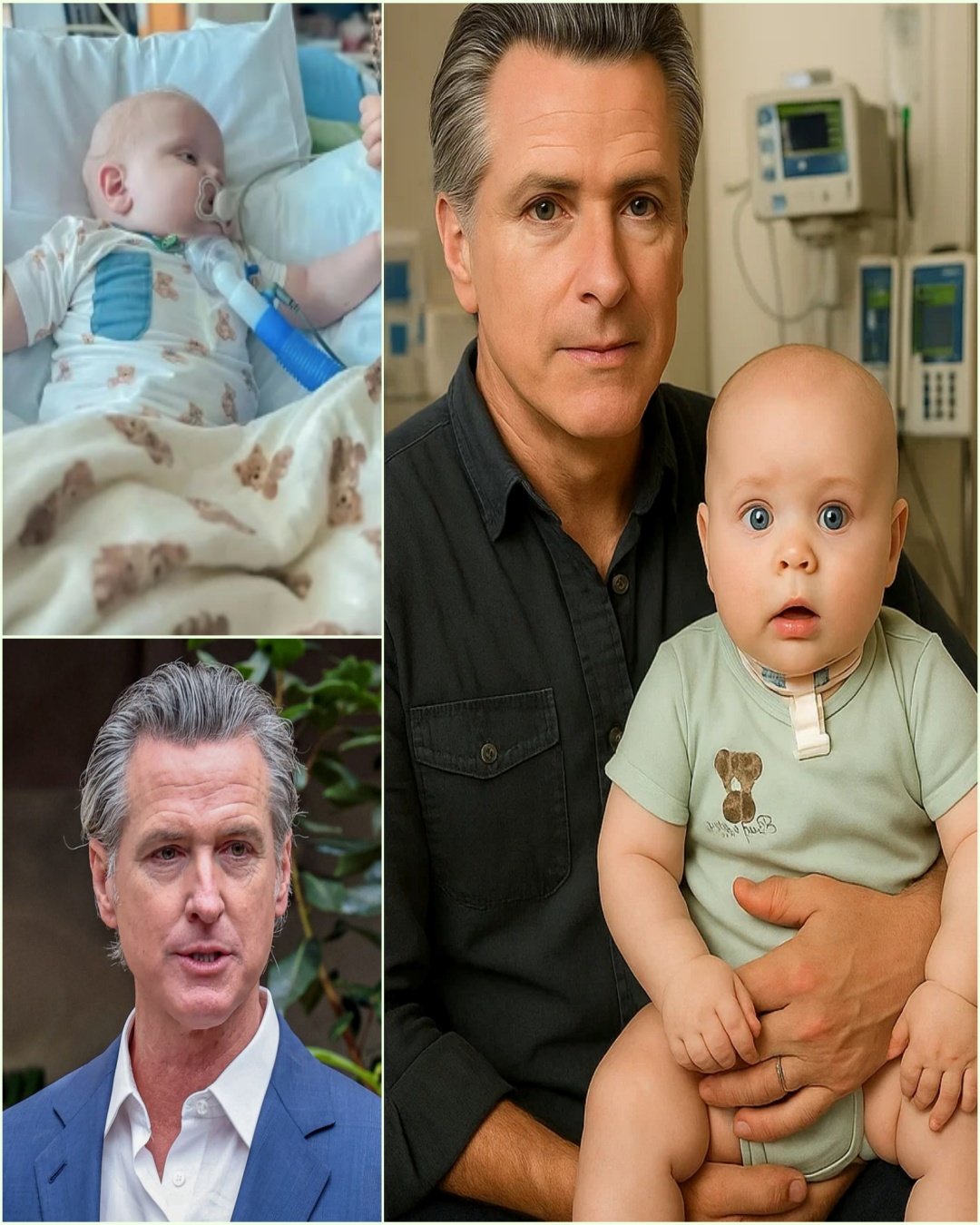
The story did not begin with headlines, nor with political statements, nor with press releases crafted in polished language. It began quietly, almost invisibly, in a small hospital room where a 15-month-old child fought a battle far larger than his tiny body should ever have been asked to endure. Machines hummed. Nurses whispered. His parents prayed with voices hoarse from crying. And in that dim, fragile space—long before the world knew his name—a child called Barrett, lovingly nicknamed “Brave Bear,” held on to life with a strength that defied reason.
His parents would later say there were nights they expected the worst. Nights when the doctors’ faces carried a heaviness that no parent ever wants to interpret. Nights where time felt frozen, and hope felt like a thin thread fraying at the edges. ATRT cancer was rare, brutal, and merciless. But Barrett, in ways no adult could explain, kept fighting. Kept breathing. Kept returning each day with a fierce, instinctive will to stay alive—like a cub refusing to surrender to the cold.
The Barnes family had not asked for attention. They had not asked for donations. They had not asked for sympathy. Their world had shrunk to hospital corridors, late-night vigils, whispered reassurances, and the constant sound of monitors beeping. Everything outside that room—the noise of politics, the chaos of the nation, the problems of millions—faded into a distant blur.
But then the world found them.
It started with a single social media post shared by a friend: a photograph of baby Barrett, small and pale, clutching a stuffed bear nearly the size of his torso. A caption below the photo read simply:
“Our little warrior is still fighting.”
Within hours, strangers began sending messages of support. Prayer chains formed across states. Comments filled with heart emojis and candle icons flooded the thread. Something about Barrett’s face—his soft cheeks, his alert eyes, the bandage on his tiny hand—pulled at hearts in a way few stories do. People who had never met the family felt connected to them. People who had never prayed before sent their first prayer. And people who had survived their own battles against illness whispered quiet blessings into the digital void.
But no one expected the story to cross the path of Gavin Newsom.
He encountered it late at night, long after most of the staff in his building had gone home. The halls were quiet. Papers lay scattered across a desk filled with policy drafts and reports. He rubbed his eyes, exhausted from a day that had felt heavier than usual. Then, scrolling absentmindedly through news articles and social media posts, he saw the picture of Barrett.
The image froze him.
Not because Barrett was sick. Not because the situation was tragic. But because he saw something familiar in the child’s eyes—a determination that reminded him of moments in his own life where survival meant fighting through darkness, through pain, through the unbearable. And then he saw something else: the medical fundraiser link, sitting quietly beneath the post, with a goal far from being reached.
He clicked it.
He read the family’s story slowly, carefully, as if absorbing each sentence with the weight it deserved. The treatments. The surgeries. The late nights. The fear. The impossible bills. The hope that flickered like a candle in the wind but somehow never fully went out.
And somewhere between reading and breathing, something inside him settled with clarity. Not a political move. Not a strategic gesture. Something human.
He made the $50,000 donation quietly.
No announcement.
No press.
No spotlight.
Just a contribution placed into a system that would notify the family without revealing the donor unless he allowed it.
It could have ended there.
But fate doesn’t always close a story where we expect it to.
The Barnes family received the notification the next morning. Barrett’s mother, sitting in a chair beside her son’s hospital bed, stared at her phone for several seconds before she could even speak. Tears spilled before words did. Her husband leaned over, read the amount, and let out a trembling exhale that sounded almost like a prayer breaking free from disbelief.
The staff members who happened to be in the room paused, unsure whether to speak or silently witness the moment. The air filled with a mixture of relief, gratitude, and something deeper—something like hope catching flame again after nearly going cold.
Within hours, the donation went public—not through Newsom, but through the Barnes family, who wanted people to know how one act of kindness had lifted an impossible burden from their shoulders.
That was when the story exploded.
News outlets ran segments.
Commentators discussed it.
People on social media wrote long threads about empathy, humanity, and the rare moments when politics fades and compassion steps forward. Even those who disagreed with Newsom on every political issue admitted, perhaps reluctantly, that the gesture was undeniably moving.
But the heart of the story was not the donation. And it was not Newsom.
It was Barrett.
More and more people began following the child’s journey. They learned that he had undergone surgeries that left scars across his tiny skull. They learned that doctors had warned his chances were low—that ATRT cancer was relentless. They learned that the Barnes family had spent months living in hospital rooms, rotating shifts to make sure someone was always at Barrett’s side.
And they learned that, despite all odds, Barrett had survived.
People called him “the bravest little bear the world has ever known.”
And somehow, impossibly, it felt true.
Videos of Barrett smiling began circulating online—small recordings of him gripping hospital rails, rolling on a mat during therapy sessions, giggling when nurses made silly faces. His resilience began to feel like a collective victory, something that brought millions together in a way few stories could.
And yet, beneath the celebration, the emotional core of the story remained quietly rooted in something much more intimate: the courage of a family who refused to surrender, even when surrender felt easier. The fierce love of parents who held their child through fear, pain, and uncertainty. And the inexplicable, unbreakable will of a little boy whose fight had inspired a nation.
The donation was a spark.
Barrett was the fire.
And soon, other people stepped forward, offering support, sharing resources, sending messages, donating what they could. A community began to form around a child who had no idea how many hearts he had touched. Each post, each update, each photograph became a reminder that compassion—real compassion—can create ripples far beyond what any individual expects.
Days passed. Weeks passed. Barrett’s condition improved. His hair began to regrow. His doctors used the word “miracle” more often. Nurses said he smiled at them even on days when the treatments left him exhausted. His parents, though still shaken from everything they had endured, began to speak with relief rather than fear.
As for Newsom, he continued on with his responsibilities, rarely speaking about the donation. But those close to him said the story stayed with him—that he would occasionally ask for updates, quietly, respectfully, without the need for attention.
Because in the end, this was not a political story.
It was a human one.
A story about how the smallest among us can teach the greatest lessons.
A story about how generosity can appear unexpectedly, like sunlight breaking through storm clouds.
A story about survival—not just of the body, but of the spirit.
A story about a little boy called Brave Bear, whose life became a reminder that hope is never as fragile as it seems.
Barrett may never know the full scope of the movement he inspired.
He may never understand how many people prayed for him, cried for him, rooted for him.
He may never comprehend how a quiet donation became a symbol of compassion in a divided country.
But perhaps that is the beauty of it.
Perhaps the greatest stories are the ones whose heroes don’t know they’re heroes.
And somewhere, in a small house lit by morning sun, a child who once fought death itself now laughs—a soft, bright sound that feels like the world beginning again.