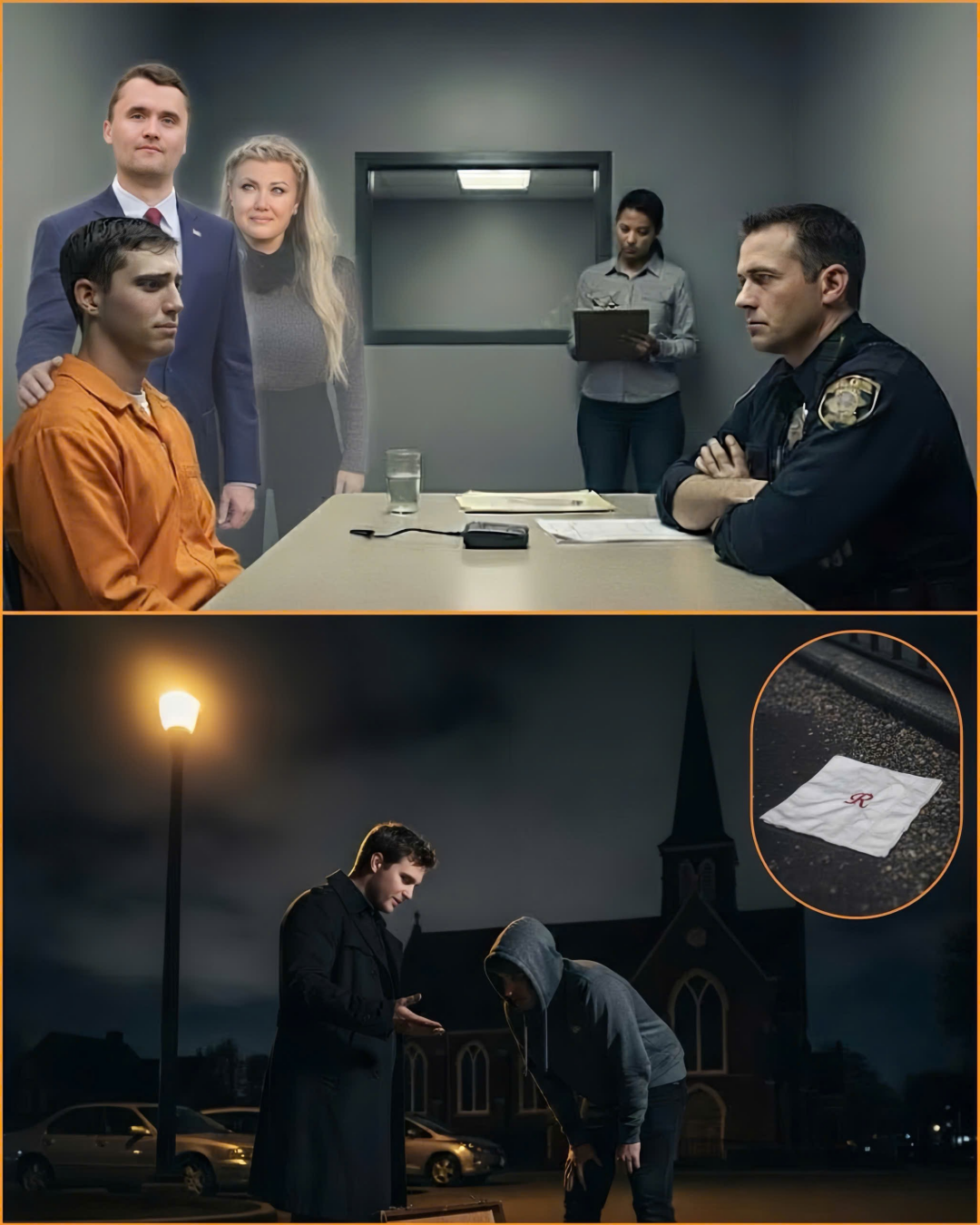
BREAKING: “That Night Behind the Church” Just Got a New Detail — and It May Have Shifted the Entire Case
The phrase was only a sentence, delivered at the edge of a hearing when most people assumed the moment had passed.
But when Tyler Robinson pointed to “that night” in the parking lot behind the church, it didn’t land like a dramatic flourish. It landed like a coordinate—specific enough to be checked, specific enough to be compared against records, and specific enough to make people wonder whether the case had been pointing in the wrong direction all along.
Now, a new claim is gaining traction: a set of internal notes tied to that exact location has reportedly been passed to investigators, and portions of what’s inside are said to match—uncomfortably well—what Tyler was hinting at.
To be clear, none of this has been formally released in court filings through the materials shared publicly in the narrative circulating online. The details below reflect what sources and secondary accounts say is being discussed behind the scenes. Still, in investigations like this, even the suggestion of a document can trigger a chain reaction: witnesses turn nervous, timelines get re-checked, and names that were once peripheral suddenly become central.
And according to the reporting thread spreading right now, this is exactly that kind of moment.
A Notebook, a Location, and Three “Game-Changers”
The alleged internal notes are described not as a glossy report, not as a police memo, and not as a dramatic “smoking gun.” Instead, what makes them unsettling is their simplicity: a collection of observations connected to activity around the church area on the night in question.
The rumor has crystallized around three points—three fragments that, when placed together, hint at something bigger than one person and one storyline.
First: a list of people seen around the area that night, including one name that has never been mentioned publicly.
This isn’t being framed as a definitive suspect list. It’s being framed as a “who was there” record—something that could have started as routine vigilance, community documentation, or informal tracking after smaller disturbances around that location. But in a case where the public has been starved for clarity, even a simple list becomes explosive if it includes someone new.
The most repeated detail is also the most provocative: one name—unrevealed, unconfirmed, and allegedly not introduced in public discussions—appears in that set of notes in a way that raises eyebrows. That alone is enough to shift attention, because it implies investigators may be staring at a wider circle than the public realizes.
Second: a short description of a strange conversation near the parking lot—sounding like two voices, not one.
Here, the accounts get eerily consistent. The notes allegedly do not describe a crowd. They don’t describe chaos. They describe something quieter: a brief exchange, a tense talk, a moment that didn’t seem important until later.

One voice, according to the descriptions circulating, was subdued—controlled, low, as if trying not to be heard. The other voice was described as tight, restrained, like someone attempting to keep a situation from escalating.
The significance is obvious: two voices suggest two participants. And if two participants were present near the parking lot behind the church, it reframes the meaning of Tyler’s emphasis on that spot. It would also explain why a single phrase could shake a room: not because it was poetic, but because it pointed to a scene where someone else may have been standing.
Third: a small item left behind near the area, and sources say it doesn’t belong to Tyler.
This is the detail that turns curiosity into fixation. Because an object—any object—does something that speculation can’t: it narrows the universe of possibilities.
The accounts don’t agree on what the item is, and the narrative that it “doesn’t belong to Tyler” is presented as a source claim rather than a proven fact. But the implication is what’s fueling the buzz: if something was left behind and it’s not tied to Tyler, then investigators have a new thread to pull—one that could point to a second person, a second set of movements, or a second set of motives.
In cases where people argue endlessly about intent and responsibility, an item near a location can become a pivot point. Not because it “solves” anything instantly, but because it forces a different question: Who else was close enough to leave something there?
Why the Family Reaction Matters
The storyline online doesn’t only focus on investigators. It focuses on reaction—particularly from Charlie Kirk’s family and Erika Kirk.
The reporting thread claims that when these details surfaced, the family’s response was immediate and intense—described as recognition, not confusion. More than one account suggests a moment of emotional collapse not because the information was new, but because it sounded familiar, as though it lined up with something they had heard before, suspected before, or been afraid to say out loud.
This “recognition” element is impossible to verify from the outside. But it’s also the part that resonates with the public, because it fits a pattern people understand: families often know the emotional truth of a story long before the public sees the evidence.
If the family reacted strongly, the question becomes: what exactly did they recognize?
A place? A name? A detail that has been hovering in the background, unnamed, unspoken—until now?
The Real Shift: From “What Happened?” to “Who Else Was There?”
Until the “behind the church” detail took over, the public conversation around the case largely circled the same themes: Tyler’s statements, courtroom tension, and a broader debate over what really occurred.
But these new claims—notes, voices, an item, a name—push the story into a different lane. It becomes less about one person’s narrative and more about structure:
If a second person exists, what was their role?
Were they present the entire time, or did they appear at a critical moment?
Were they a witness, a participant, or a pressure point Tyler is protecting?
If a name exists on a list, why hasn’t it been discussed publicly?
If an item was left behind, who has it now—and how was it documented?
This is the kind of shift investigators often look for: a way to test whether an event was linear or layered. A single-person story is easier to understand. A two-person reality is messier—and it’s also closer to how many real incidents unfold.
Why This Moment Is Catching Fire Now
The timing is part of why the public is locked in. The “parking lot behind the church” line is fresh in everyone’s mind, and the alleged appearance of notes tied to that location makes the line feel less like rhetoric and more like an intentional breadcrumb.
If Tyler wanted attention, there are easier ways to get it than pointing to a specific place. That specificity is what keeps people up at night, because it suggests either knowledge… or a deliberate attempt to force investigators to look somewhere they weren’t looking hard enough.
And that brings us to the question that has now swallowed every other question:
Who was the other person—and why is the story trying so hard not to say their name?
Because if the hidden name is real, if the two voices are real, and if the item truly isn’t Tyler’s, then the case isn’t just “turning.”
It’s widening.
And once a case widens, it doesn’t simply add details—it starts changing what everyone thought the beginning even was.