On November 15, 2025, in a quiet neighborhood where days usually pass without incident, smoke began curling into the sky—thin at first, then thick enough for neighbors to step outside, look upward, and feel that sinking instinct that something was wrong.
By the time emergency crews arrived, the home was no longer a home at all. Flames had eaten their way through the rooms, through the walls, through every corner where once a family lived. The roof sagged inward. Windows had exploded outward. And the heat was still strong enough that firefighters had to wait before they could safely enter.
Inside that burning structure were four people: a father and his three young children.
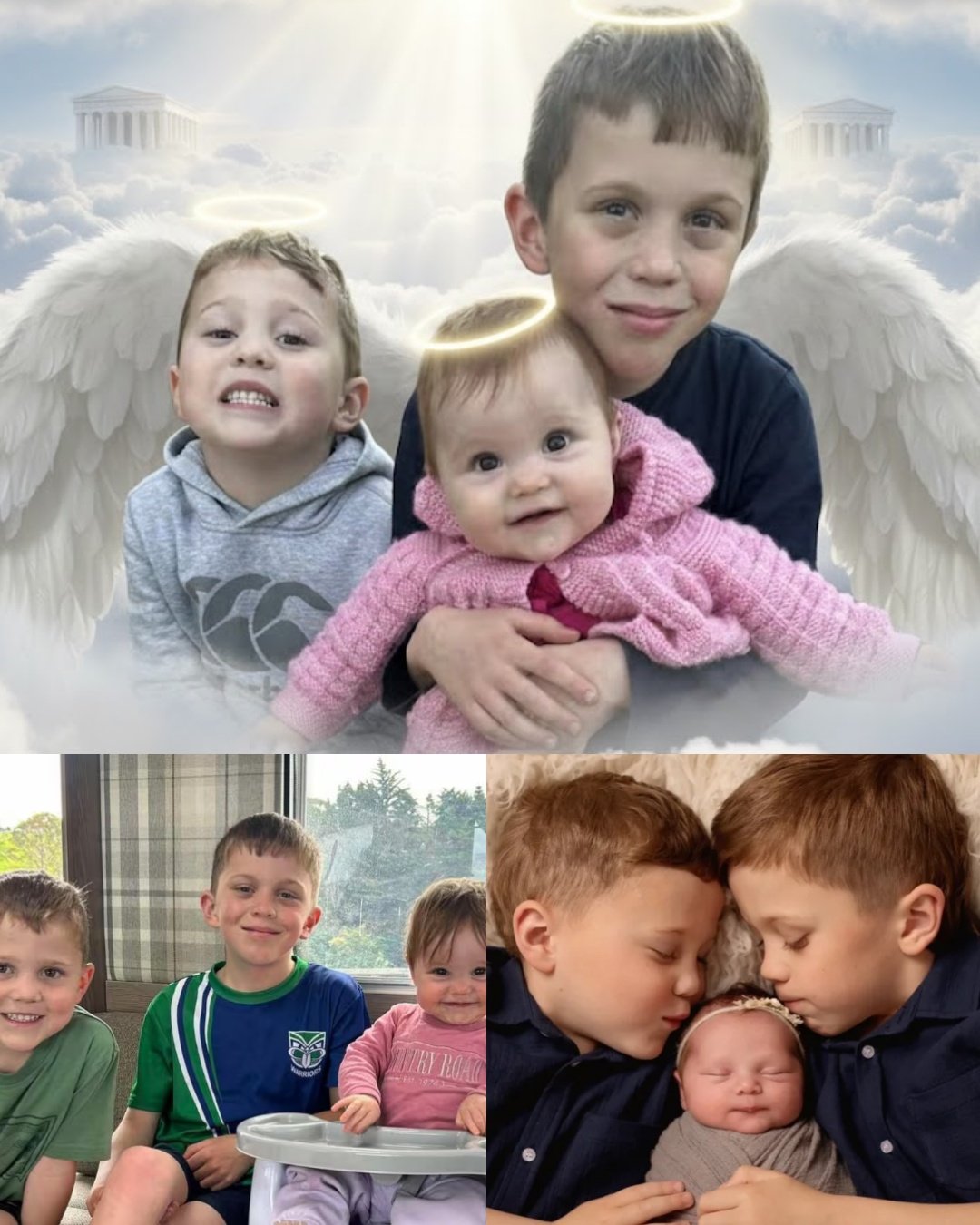
Goldie — only one year old.
Hugo — just five.
August — seven, the oldest, barely old enough to understand anything about danger.
All of them gone long before the flames were put out.
But as investigators began sifting through the ashes, trying to piece together what had happened inside those final minutes, the truth took a darker, more bewildering turn—one that now haunts an entire community and raises a question no one wants to ask:
Did the fire destroy them?
Or was someone destroyed before the fire ever began?
This is the story of a family erased in one morning—and a small town left desperate for answers.

THE DISCOVERY THAT CHANGED EVERYTHING
When firefighters finally pushed through the smoke and stepped inside what was left of the home, they found the bodies of the three children together. Their small frames lay in positions that suggested no chance of escape—no chance to run, to call for help, or to reach a door before the smoke overcame them.
Nearby was the father.
But there was a problem—one investigators noticed immediately.
His body showed no signs of burn injuries.
Not on the skin.
Not on the clothing.
Not in the lungs.
It was the first indication that something far more disturbing had unfolded before the fire ever ignited.
A fire can take lives.
But a fire cannot take a life without smoke in the lungs
.
And so the question formed, quiet at first, then louder, then undeniable:
How did the father die—if not from the flames?
And why were the children in the house, unable to escape?
The family’s dog was also found inside, lifeless.
Only the children’s mother survived—because she wasn’t home at the time.
A detail that would haunt investigators in the hours to come.
A HOUSE FULL OF QUESTIONS
The home was small, modest, the kind families use to build memories, not mysteries. Toys outside. A bike left by the shed. Curtains picked out with care. Everything normal. Everything ordinary.
But behind the scorched doorway, there were signs that what happened that morning was anything but ordinary.
Police quickly sealed off the area.
Yellow tape went up.
Forensic investigators walked silently through the rubble.
It didn’t take long before early findings pointed toward a single chilling theory:
Murder-suicide.
A phrase that hits like a blow to the chest.
A phrase that no one in town wanted to hear.
A phrase that opened a door to a type of horror more frightening than the fire itself.
Because murder-suicide doesn’t just describe a moment.
It describes intent.
A decision.
A plan.
A thought carried forward with devastating consequence.
But even as investigators shared their preliminary conclusions with caution, they knew the public’s question wouldn’t go away:
What exactly happened inside that home before the flames began to rise?

THE FINAL MOMENTS: WHAT LITTLE WE KNOW
Fire investigators can read a house the way detectives read a crime scene. The direction of burning, the collapse pattern, the smoke trails—each one tells a fragment of the story.
From those fragments, one devastating outline emerged:
The fire started inside the home.
The children were alive when it spread.
But the father was almost certainly not.
Something happened to him before the fire began.
Something violent.
Something deliberate.
Something fatal.
And then, moments—or minutes—later, the house was set ablaze.
Whether the children were already unconscious when the fire began remains unclear.
Whether the father’s death came by his own hand or at the hands of someone else remains unproven.
Whether the fire was lit to hide the truth rests at the center of the investigation.
What is known is that by the time firefighters broke through the smoke, the tragedy had already reached its final, irreversible outcome.
THE ONLY SURVIVOR
The mother.
Her absence from the home saved her life.
Her return to it destroyed everything else.
Neighbors describe the sound of her collapse, the way she screamed when she arrived and saw smoke still rising from the roof.
They describe how she ran forward until officers held her back, how she pleaded to be allowed inside even after firefighters had already found the remains.
“How? Why? What happened?”
Her voice broke, witnesses said.
She asked the same questions investigators still can’t answer.
For now, she is the only one left who can speak for her children.
The only one who can identify their belongings from the debris.
The only one who can describe the last time she saw them alive.
And the only one who now carries grief too heavy for the human heart.

THE TOWN OF SANSON: A COMMUNITY IN SILENCE
Sanson is small—so small that people don’t just know each other; they know each other’s children, each other’s schedules, each other’s joys and struggles.
News spreads fast in a place like that.
Tragedy spreads faster.
By noon, the entire town knew that three children and their father were gone.
By evening, candles lined the sidewalk near the burned home.
Stuffed animals.
Handwritten notes.
Photos printed and placed gently among the ashes.
People didn’t speak loudly.
No one wanted to speculate.
The silence felt like respect—like grief held carefully, cautiously.
But behind closed doors, behind the careful condolences and whispered prayers, the questions simmered:
Did the father plan this?
Was he experiencing something no one knew about?
Was he trying to escape something?
Did he harm the children—or try to protect them from something worse?
Was someone else involved?
There are no answers.
Just shadows of possibilities too painful to explore.
THE CHILDREN WHO SHOULD HAVE GROWN UP
The heart of the story isn’t the fire.
It isn’t the investigation.
It isn’t even the unanswered questions.
It’s the children.
Goldie — still learning her first words.
Hugo — five years old, full of energy and imagination.
August — seven, old enough to help his siblings, young enough to still need help himself.
Their laughter once filled the home.
Their toys once scattered the floor.
Their drawings once hung on the refrigerator.
Their future should have been long.
Messy.
Loud.
Beautiful.
Instead, their names now belong to memorials.
They deserved to grow up.
They deserved birthdays.
They deserved school years and summers and first loves and second chances.
They deserved everything a fire—and perhaps something more—took away from them.

THE INVESTIGATION CONTINUES
Forensic teams are still analyzing:
Air samples.
Burn patterns.
Toxicology reports.
The father’s autopsy.
The children’s autopsies.
Electronic devices.
Texts.
Call logs.
Financial records.
Mental health history.
Any sign of outside involvement.
Any sign of a struggle.
Any sign of premeditation.
Because until those tests come back, investigators will not publicly label the tragedy as murder-suicide.
They are cautious.
Careful.
Methodical.
But they are also realistic.
Something horrifying happened inside that home.
Something that wiped out an entire family in minutes.
Something that left a mother standing alone in a world that once held everything she loved.

THE QUESTION THAT WON’T LET GO
Every tragedy eventually leaves behind a single, haunting question.
In this case, it is this:
What really happened in the minutes before the flames?
Was it despair?
Was it rage?
Was it fear?
Was it a plan?
Was it an accident that spiraled?
Or was it something no one has even imagined yet?
Investigators don’t know.
The community doesn’t know.
The mother, perhaps, will never know.
But the truth is buried somewhere in the ashes.
And slowly, carefully, piece by piece, forensic teams are sifting toward it.
A TOWN WAITING FOR ANSWERS
The home is gone.
The fire is out.
But the story is far from over.
Autopsy results are pending.
A final determination has not been made.
The mother remains shattered.
The town remains silent.
The case remains open.
Because justice—even when it cannot bring anyone back—must still be found.
And in a tragedy like this, the truth matters.
For Goldie.
For Hugo.
For August.
For the father.
For the mother who now stands alone.
And for every parent who now holds their children a little tighter, realizing how fragile life can be.
The deeper, more unsettling details of this case—the timeline, the evidence, the theories investigators are exploring—continue below.