In December 2021, Louise and Ollie received what felt like the perfect early Christmas gift — two faint pink lines on a pregnancy test. Already blessed with two healthy daughters, they imagined another smooth pregnancy and another joyful chapter added to their growing family. But their journey with baby number three would prove to be unlike anything they had ever experienced.
The day of the dating scan arrived, bringing with it the familiar tension Louise knew too well after enduring multiple miscarriages. As soon as the baby appeared on the screen, heart flickering strongly, she exhaled with relief. She even found herself squinting at the monitor, wondering whether the tiny figure was a boy or a girl — far too early, but a comforting distraction.

The scan, however, seemed to stretch on. The sonographers exchanged glances, swapped roles, then stepped out quickly. Ollie leaned over and whispered, “Do you think something’s wrong?” Louise shook her head, determined to believe what she desperately needed — that the baby was simply too wriggly.
Minutes later, a third sonographer began rescanning, this time focusing intensely on the baby’s heart. Soon after, the couple was escorted into a counseling room with a small table and a box of tissues — a room that no expectant parent ever wants to see.

There, they heard the words that shattered their world:
“We think your baby has transposition of the great arteries.”
Louise felt the air leave her lungs. The specialist explained the condition using diagrams, the risks, and the options — including the option no parent ever wants to hear. Though the doctor reassured them that TGA has strong surgical outcomes, Louise could only think about one thing:
“There is nothing worse than meeting your baby… and then losing them.”

Then, by sheer good fortune, the hospital’s visiting cardiologist — on site at that exact moment — performed a scan and confirmed the diagnosis.
A pregnancy lived between hope and fear
The first week after the diagnosis was a blur of shock. Practical questions collided with heartbreak: how do we plan? What do we prepare for? How do we manage the logistics of birth and surgery?
From that point forward, the pregnancy became a carefully monitored, emotionally heavy journey. Louise and Ollie attended appointment after appointment, always feeling reassured yet acutely aware of the fragility of what lay ahead.

At one visit, the consultant expressed amazement that the sonographer had detected TGA at the dating scan. The baby’s heart would have been no bigger than a grain of rice — almost impossibly small. Louise still feels immense gratitude to the person who caught it.
A fetal MRI revealed the hole between the upper chambers of the heart was tiny, meaning their baby would need an atrial septostomy immediately after birth. Doctors recommended a planned C-section so a full team could be ready.
Oddly enough, the knowledge brought comfort. There was a plan. And the baby would be born exactly where she needed to be.

Emi’s birth — and the fight that began instantly
On the day of the C-section, Louise felt strangely calm. As soon as Emi arrived, she cried — loud, strong, pink, and fighting. But the moment the cord was cut, her oxygen levels plummeted.
The team acted fast, ventilating her within moments. Louise remembers wanting to speak to her — to tell her she was loved — but the words couldn’t escape through the shock.
A few hours later, they received the call:
The first procedure had been successful. The atrial septostomy worked.
Step one was complete.
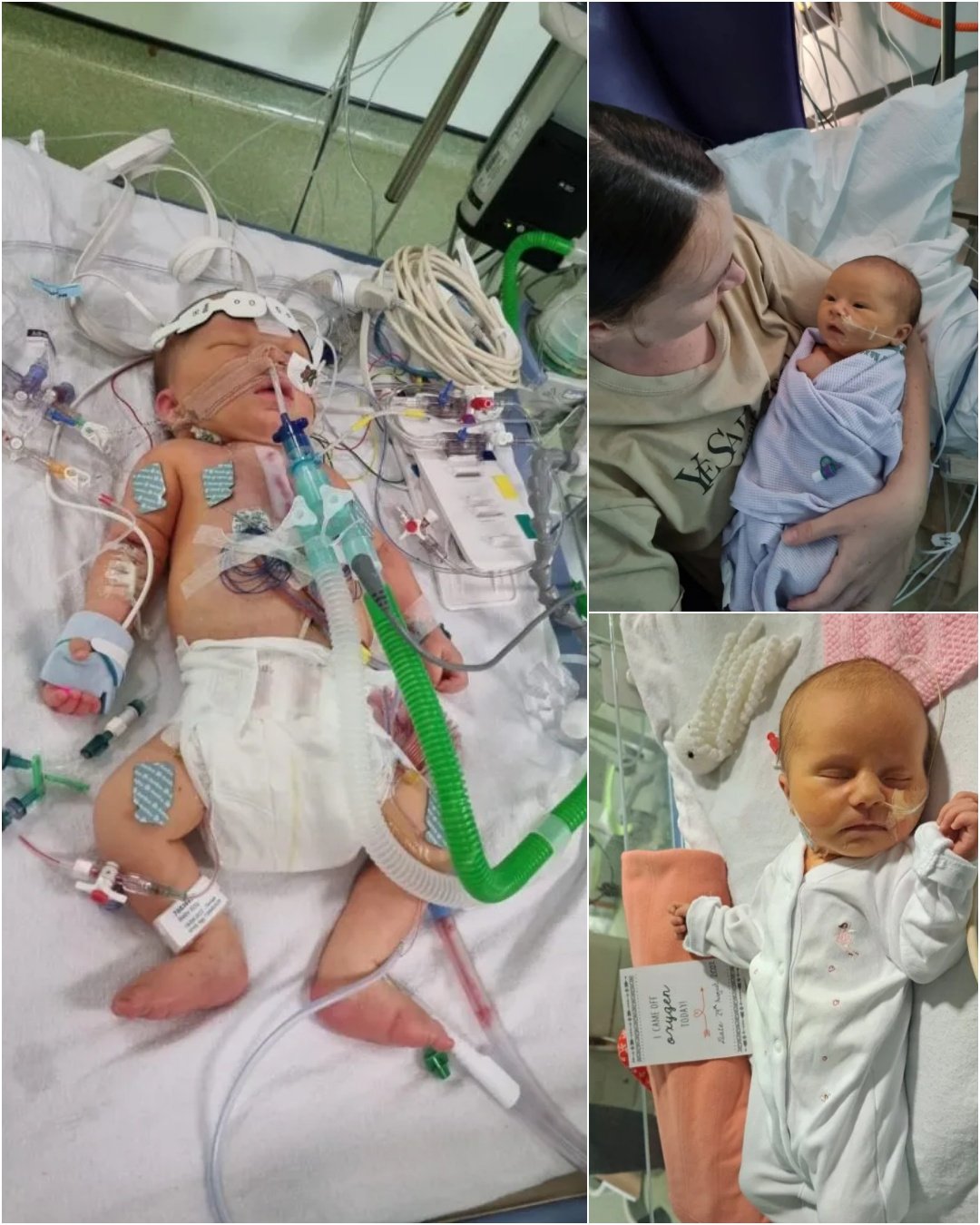
When Louise finally saw Emi properly, the NICU felt peaceful, almost protective. Emi looked plump and serene despite her fragile heart. But appearances were deceiving. At five days old, the team prepared for the major arterial switch operation.
Louise and Ollie kissed her, whispered their love, and watched her roll away on a trolley, feeling as though their hearts were being carried with her.
Six hours that felt like a lifetime
They passed the time as best they could — grabbing coffee, talking to friends who happened to be at the hospital for their own child, trying to stay anchored. When the call finally came, relief washed over them:
The surgery had gone well. Emi was stable in PICU.
But nothing prepares a parent for seeing their baby post–open-heart surgery. Emi was swollen, covered in wires, surrounded by machines. Yet the nurses welcomed questions, explained everything, and guided them through each frightening moment. Their compassion made all the difference.
Emi faced complications — fluid around her lungs, partial lung collapse, time on dialysis. But on day five, she surprised everyone:
She came off the ventilator.
Then off the oxygen.
Then she cried — loud and strong.
Louise remembers thinking, “How can babies progress this quickly?”
But Emi wasn’t just any baby. She was fighting her way back to them.
Within days, she was in her first outfit, monitors disappearing one by one. Soon, she was feeding well, gaining weight, and finally — blessedly — ready to go home.
Three weeks after birth, they carried her out of the hospital.
A thriving, vibrant little girl
Today, Emi is two years old — wild, joyful, spirited, and utterly unstoppable. She meets every milestone with determination. Her most recent heart scan showed normal function, a result that once felt impossible.
Louise still holds her tightly every single day, aware of how close they came to losing her.
To parents just beginning their heart journey, she offers this:
“There is hope. There is a community who understands. And miracles happen, even on the hardest days.”
Emi’s story is a reminder of the power of early detection, the brilliance of medical teams, and the resilience of a tiny girl who arrived with a broken heart — and left the hospital with the strength to live a beautiful life.
With love and hope,
Louise