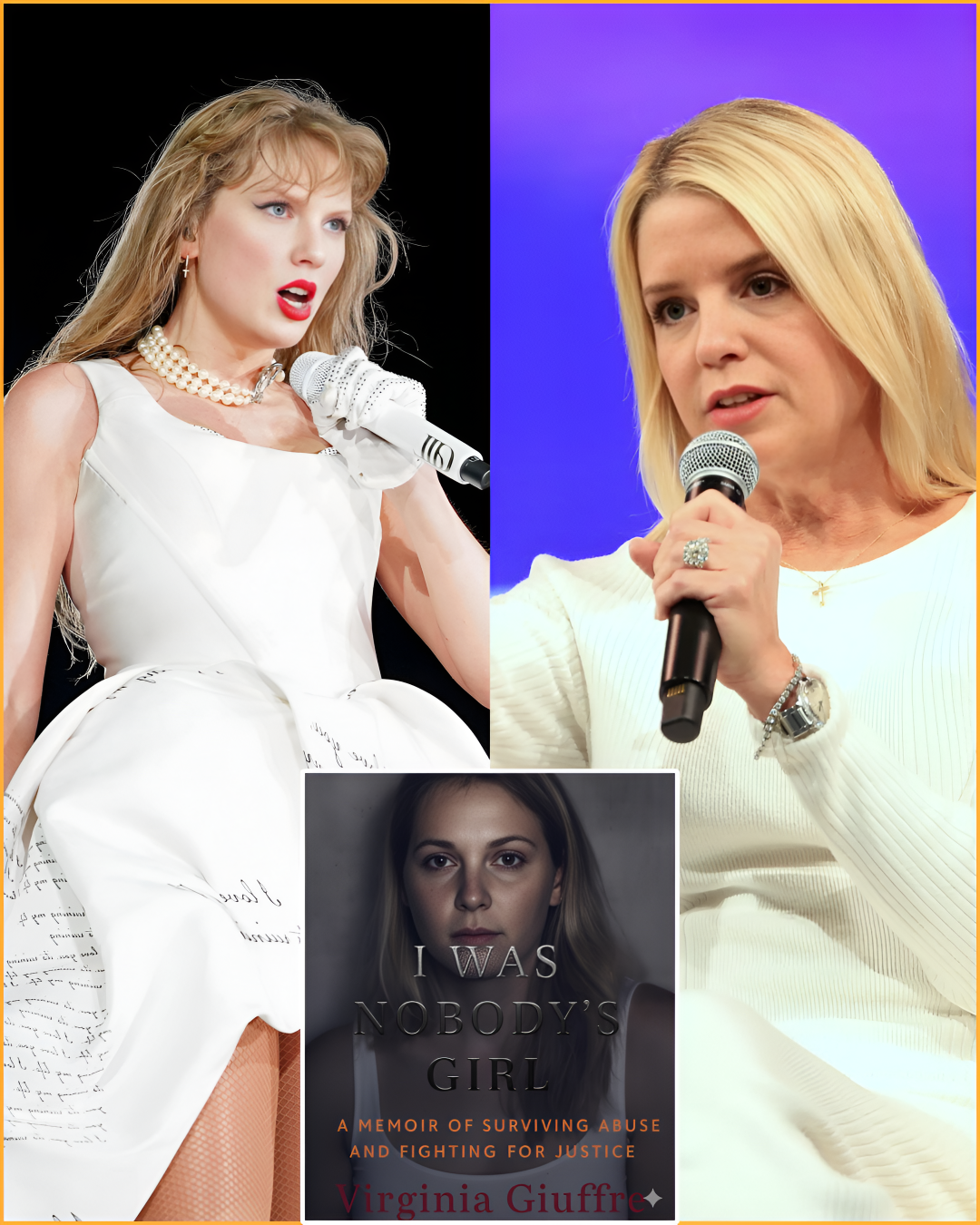
**“SEVENTEEN YEARS LIVING IN THE SPOTLIGHT — I CAN SET IT ALL ASIDE JUST TO PURSUE THE TRUTH TO THE VERY END.”


“READ THE BOOK, PAM — AS AN AMERICAN WOMAN, DON’T SHOW THE WORLD SUCH A PETTY FEAR.”**
The room fell silent long before she finished the sentence. It wasn’t the usual kind of silence that follows a glamorous performance or a standing ovation. It was the heavy, breath-held stillness that fills a space when someone says something that cannot be ignored.
Because this time, Taylor Swift wasn’t holding a guitar.
She wasn’t surrounded by dancers, pyrotechnics, or screens glowing in a thousand colors.
She wasn’t singing the songs that built her empire.
She was imagined standing behind a simple podium — no spotlights, no choreography — delivering a message described as directly aimed at Pam Bondi, a message so sharp and unflinching that even those who admired Taylor for years admitted they had never seen her like this.
“SEVENTEEN YEARS LIVING IN THE SPOTLIGHT — I CAN SET IT ALL ASIDE JUST TO PURSUE THE TRUTH TO THE VERY END.”

It wasn’t just a sentence. It was a line drawn in the sand.
People in the room — assistants, reporters, staffers, even those who had walked in with skepticism painted on their faces — froze in place. For a moment, no one dared breathe. The weight of seventeen years, the evolution from teenage prodigy to global icon, condensed into one declaration of principle.
Then came the second blow, one that felt less like a criticism and more like a challenge:
“READ THE BOOK, PAM — AS AN AMERICAN WOMAN, DON’T SHOW THE WORLD SUCH A PETTY FEAR.”
Those words hung in the air like a spotlight swinging onto a truth long avoided. It wasn’t delivered in anger. It wasn’t shouted. Taylor didn’t slam her fist or raise her voice. She simply spoke — and every syllable cut sharper than a scream could have.
In that imagined moment, people weren’t looking at the singer of chart-topping ballads. They were seeing a woman standing at a microphone not to entertain, but to confront. Not to charm, but to demand clarity. Not to spark applause, but to spark accountability.
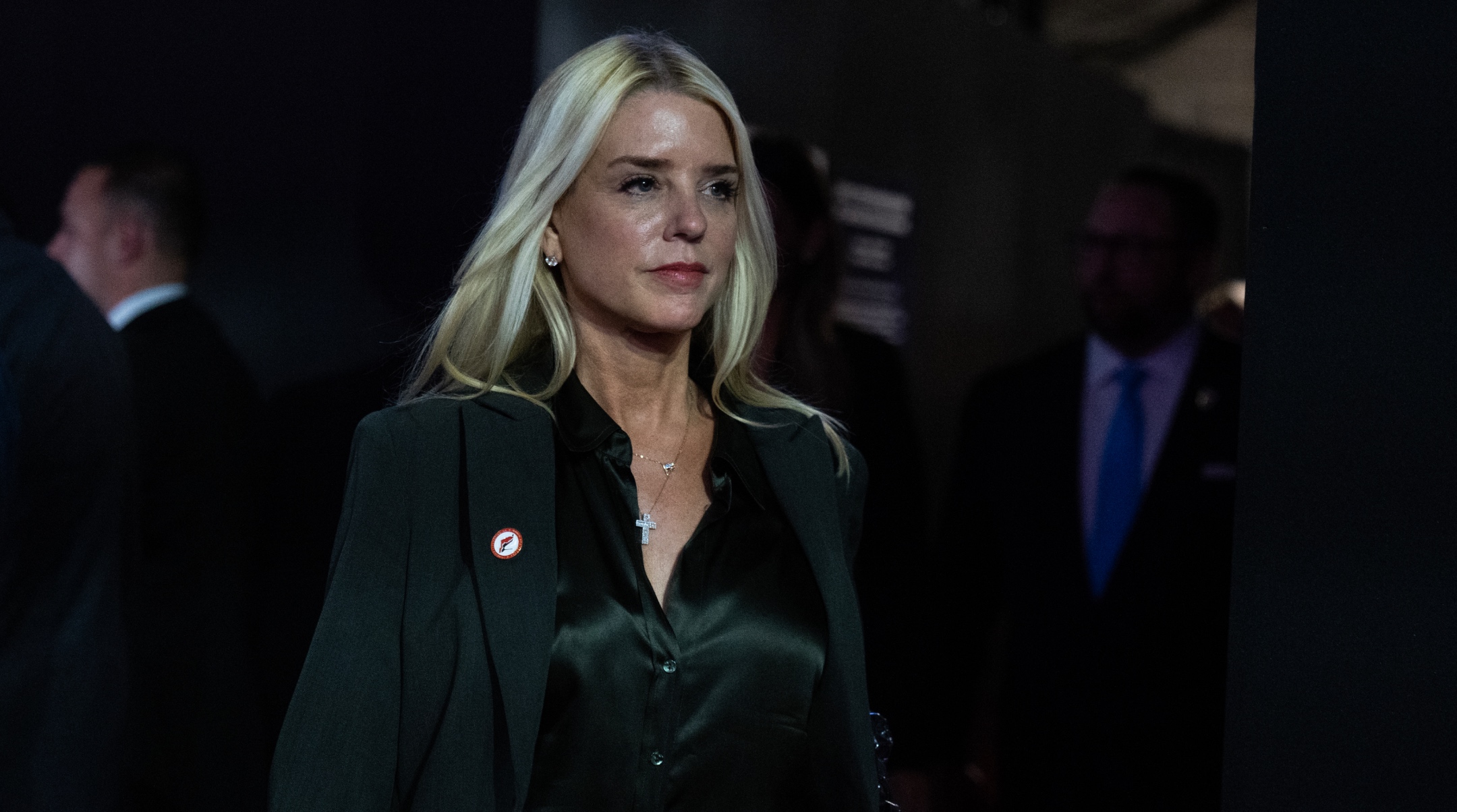
Her voice, described as soft but lethally precise, carried a conviction that pierced through the quiet:
“When a woman seeking the truth is turned away, that is not principle — that is cruelty.”
The audience shifted — some in discomfort, some in admiration, some in the kind of shock that comes only when someone tells a truth that has been whispered for too long. Taylor wasn’t performing. She wasn’t crafting lyrics. She was naming something that needed to be named.
Then, in a gesture unmistakably hers, she stepped back from the podium and pressed a hand against her chest — the same gesture fans have seen during speeches that mattered, moments when she spoke not as a superstar, but as a human being.
Her next words carried a determination that made the moment feel even larger:
“If I have to trade seventeen years of my career to protect those without a voice, I am still willing.”
Gasps. A few hands covering mouths. An echo of murmurs rippling across the room.
And then — applause. Not polite applause. Not the kind born from routine respect. But applause that crashed like waves, applause from people who understood they were witnessing a rare collision between fame and moral courage.
Online, the reaction was instant and explosive.
Fans, critics, journalists — even those who usually stayed silent — flooded social media.
#SwiftForJustice
#SpeakNowForTruth
#TruthOverSilence
Within minutes, those hashtags rose like a storm, threading through timelines, creating a digital roar that drowned the usual noise of entertainment news.
Commentators called it “one of Taylor’s most courageous moments.”
Some said it felt like “a political earthquake disguised as a message.”
Others believed it was “the clearest sign yet that she is no longer afraid of confronting power.”
But beyond the headlines, beyond the endless debates and reactions, one sentiment stood out:
This was not just a message to one person. It was a reflection of the woman Taylor Swift has become.
Because for seventeen years — through awards, scandals, victories, heartbreaks, reinventions, and eras — there has been one constant thread woven through her story: the courage to stand for the truth, even when it isolates her, even when it costs her, even when it forces her to look straight into a storm that others would choose to walk around.
What she said was bold.
What she implied was braver.
And what she reminded the world was unmistakable:
Taylor Swift is no longer the girl being shaped by the spotlight.
She is the woman choosing where it shines.
And in this imagined moment — this moment described as a direct challenge, a call-out, a line in the sand — she chose to shine it on the truth.
And she didn’t blink.