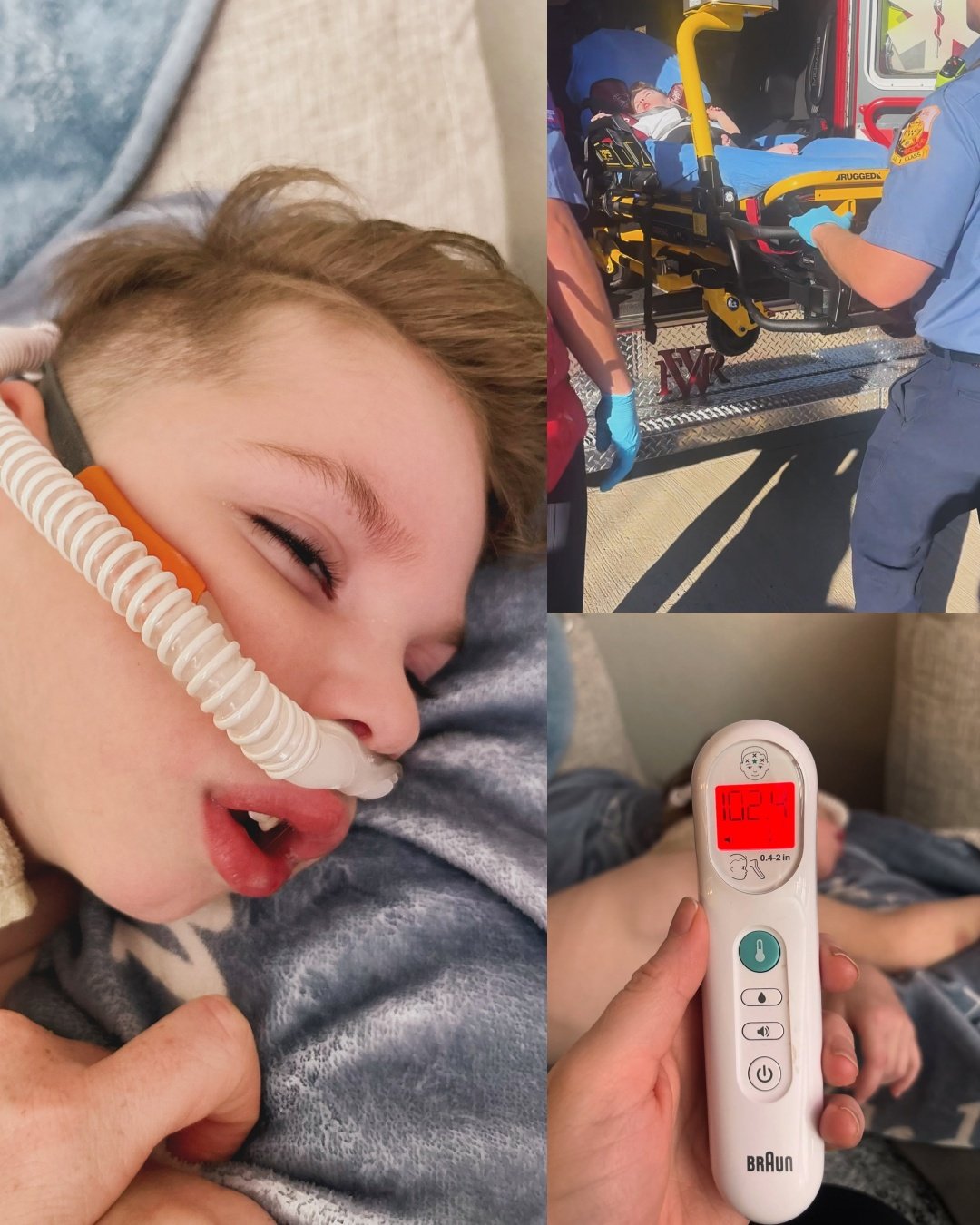
The house had barely settled into silence when the alarm of fear began to sound again.
Just thirty minutes earlier, the family had returned home — weary but relieved — after another long day at the hospital. Luke, their brave little boy, had just undergone a sedated MRI to scan his brain and spine. It was supposed to be a cautious check, one of many on his medical journey. The kind of day that families like his know all too well — filled with needles, monitors, and whispered prayers in sterile rooms that smell faintly of antiseptic and hope.
But that evening, hope began to tremble.

A Sudden Turn
Within minutes of arriving home, something shifted.
Luke’s body, usually calm after sedation, began to betray him. His temperature soared to 102.4°F. His heart raced wildly — into the 170s — thundering inside his small chest like a drum too fast for its rhythm. His oxygen levels wavered, dipping and climbing in erratic waves. The color drained from his face.
And then, there was the stillness.
He grew lethargic. Quiet. Unlike himself.

The laughter that had briefly returned in the car ride home — the small giggle when his mom promised ice cream later — was gone. In its place was silence, heavy and frightening.
That’s when the phone rang.
It was Luke’s complex care doctor from the hospital. Calm but firm, her voice carried the kind of weight that makes every parent’s heart freeze.
“Please call 911,” she said. “Do not drive him yourselves. I want him transported immediately to the emergency room.”
There was no hesitation. No time to pack a bag or grab a blanket. Just flashing lights, hurried instructions, and the familiar hum of fear filling the air once again.

The Ride No Parent Wants
The sound of sirens tore through the quiet neighborhood. Blue and red lights reflected off the windows as Luke’s small body was lifted gently into the ambulance.
His mother followed closely behind, clutching his favorite stuffed toy — the one that had been with him through every hospital stay, every test, every needle.
She had promised him that this MRI was just another step — that soon, things would get better. That home meant safety. That after all the scans and sedation, the hardest part was over.
But now, as the ambulance doors closed, home felt like a memory.
Inside, paramedics worked quickly — monitoring oxygen, taking vitals, checking IV lines. The rhythmic beeping of machines echoed through the confined space. His pulse was erratic. His breathing shallow.
His mother whispered prayers into the cold air, words tumbling between faith and desperation. “Please, God. Not again. Please let him be okay.”

A Battle Beyond Understanding
Luke’s story isn’t one of sudden tragedy or a single medical crisis — it’s a story of endurance.
For years, he has faced more than most adults could bear. Specialists know him by name. His chart is thick with reports, test results, and surgical notes. Yet behind every diagnosis, every hospital gown, there is a boy — bright, curious, stubborn, and endlessly loved.
His parents have learned the language of medicine: oxygen saturation, heart rate variability, sedation protocols, infection markers. But no amount of medical terminology can shield them from the rawness of moments like this — when numbers on a monitor hold their child’s fate.

Tonight was supposed to be ordinary. A simple recovery night after a routine scan. But chronic illness never truly rests. It waits — unpredictable, uninvited — to strike when families least expect it.
For caregivers, this is the cruel rhythm of life.
You learn to live between alarms, between phone calls, between medical terms that sound too heavy for a child’s name to carry.
And yet, you love fiercely anyway.

The Waiting Game
The emergency room was bright and cold. Nurses moved quickly around Luke’s stretcher, their voices low but urgent. IV lines were started. Blood was drawn. Monitors flashed across the screen — heart rate still high, temperature still climbing.
The attending physician asked questions his parents have answered too many times to count.
When was his last seizure?
What medications has he taken today?
How long was the MRI sedation?
Was he exposed to anyone sick?
They answered everything. But none of it felt enough.

Minutes turned into hours. The rhythmic beeps became a cruel lullaby. Each passing moment stretched thin with uncertainty.
“His oxygen is fluctuating again.”
“Let’s start fluids.”
“Run labs for infection.”
“Keep monitoring — don’t leave his side.”
Through it all, his mother sat in silence, her hands trembling as she brushed her son’s hair away from his forehead. She whispered stories — about his favorite toy truck, about his first day at preschool, about how brave he is.
Every word was a shield against fear.

The Fragile Line Between Fear and Faith
In the world of complex care, stability is never guaranteed. Parents learn to celebrate the smallest victories — a day without fever, a night without alarms, a laugh that breaks through exhaustion.
But they also learn to brace for the unexpected.
Because no matter how much they prepare, no matter how strong their child is, every hospital call feels like a reminder: life is fragile.
Luke’s family has lived this truth again and again. Each episode brings new questions — what triggered it, what will come next, how much more can his little body endure?

Yet, amid the fear, something extraordinary remains — resilience.
The kind of strength that doesn’t roar, but whispers. That doesn’t promise safety, but clings to faith anyway.
His parents have built a world around hope — the kind that glows quietly in hospital corridors at 2 a.m., the kind that keeps you upright when your knees want to give out, the kind that makes you thank strangers for prayers you’ll never hear spoken.

The Community That Prays Together
When word spread of Luke’s emergency, messages began to pour in.
Texts. Comments. Calls.
“Praying for you.”
“Stay strong.”
“Please keep us updated.”

It’s easy to underestimate the power of words in moments like these — until you’re the one sitting in a hospital room, watching monitors blink, realizing that somewhere out there, hundreds of hearts are beating in sync with your child’s.
Luke’s story has always been one that draws people together — not because of the tragedy, but because of his spirit. Because in his short life, he’s taught others what it means to fight.
He’s shown that even the smallest bodies can carry the biggest courage. That sometimes, survival itself is a miracle unfolding in slow motion.

The Hours That Feel Like Days
By midnight, the fever had stabilized slightly. The heart rate slowed — still high, but steady. His oxygen levels were holding.
Doctors remained cautious. “We’re not out of the woods yet,” one said gently. “But he’s responding.”
For his parents, those words were enough to breathe again.
They sat side by side, exhaustion written across their faces, watching their son sleep under the soft glow of hospital lights. Machines hummed. Nurses whispered. The world outside felt far away.

Time lost its meaning — it became a loop of waiting, hoping, remembering, and praying.
At one point, Luke stirred — eyes fluttering open, groggy and confused. His mother leaned close.
“Hey, buddy,” she whispered. “You’re safe. We’re right here.”
His lips moved, faintly forming words only she could understand. Maybe it was “Mom.” Maybe it was just a sigh. But to her, it was everything.

The Strength of a Family Tested Again
By dawn, the medical team had more answers. Bloodwork showed signs of infection — possibly a reaction post-sedation or a viral response that his weakened immune system couldn’t fight alone.
He would stay for observation, antibiotics started immediately.
It wasn’t the nightmare they feared most — but it was another reminder that peace in their world comes in fragments.

They exhaled in quiet relief. Gratitude, exhaustion, and faith intertwined.
His father texted a simple message to friends and family:
“He’s stable for now. Keep praying. Thank you.”
And somewhere in that fragile sentence, there was a whole story — of fear faced, of strength summoned, of love that refuses to break.

Beyond the Hospital Walls
Luke’s story is not over — because children like him redefine what survival means every day.
They remind the world that even when the body is fragile, the spirit can be unstoppable.
That sometimes, courage isn’t found in battlefields or headlines — but in a hospital room at midnight, in a heartbeat that refuses to give up, in parents who choose faith over fear again and again.
When they returned home that night, they believed the hardest part of the day was behind them.

They were wrong.
But as the sun rose over the hospital hours later, one thing was certain — no matter how many times their world shakes, they will always rise again. Together.
Because that’s what love does.
It calls 911 when fear takes over.
It rides in the ambulance.
It waits in the ER.
And it keeps believing — even when everything else trembles.