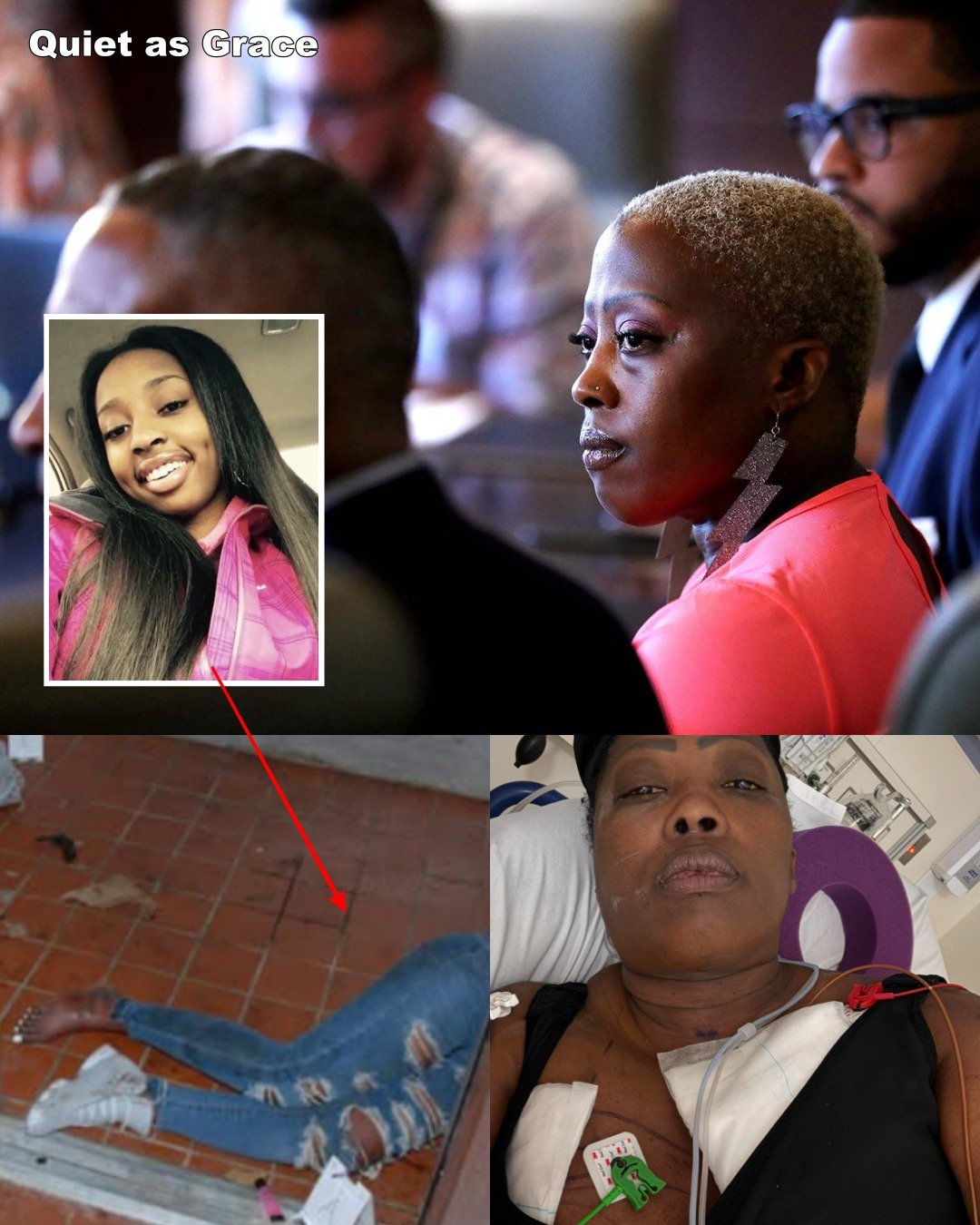
Teresa Martin had spent nearly six years living with a silence that did not belong to her.
It was a silence she did not choose, a silence that pressed down on her chest each morning she woke, a silence that wrapped itself around every memory of her daughter, Kenneka Jenkins.
And now, after years of carrying that weight alone, she finally decided to break it.
For Teresa, silence had never been an option in the beginning.

In September 2017, when nineteen-year-old Kenneka walked into the Crowne Plaza Hotel in Rosemont and never walked out alive, her mother’s world split open.
The girl who once filled their small home with laughter, loud music, and dreams of becoming a nurse was suddenly gone—found hours later in a hotel freezer, alone, cold, and with a story that never made sense to the people who loved her.
Teresa remembered the phone call that night every time she closed her eyes.
She remembered the panic in her chest as she rushed to the hotel.
She remembered begging security to check the cameras.
She remembered pacing through the hallways while staff brushed her aside, telling her to “wait,” telling her “these things take time,” telling her everything except the truth she longed to hear.

And she remembered the moment they finally told her that her daughter had been found.
It was a memory stitched with pain she would never outrun.
But what came after—she never expected that part.
According to Teresa, the days following Kenneka’s death became a blur of unanswered questions, withheld information, and the crushing weight of institutions larger than any grieving mother should ever face.
She said she asked for her daughter’s belongings repeatedly.
Kenneka’s phone.
Her clothing.
Her personal items—anything that still held a piece of the girl she raised.
But nothing was returned.
Not a sock.
Not a piece of jewelry.

Not even the phone that might have held the last moments of her daughter’s life.
“They took everything that belonged to Kenneka,” Teresa said when she finally chose to speak publicly again.
“But I was never given them back.”
It wasn’t just the belongings.
It was the feeling that the truth, too, had been taken from her.
When the lawsuits began, Teresa felt unprepared, overwhelmed, and outnumbered.
She entered conference rooms filled with lawyers in suits, papers stacked on polished tables, the air thick with formal language no mother drowning in grief could fully comprehend.
And yet, she said, she was pressured to sign.
Pressured to settle.
Pressured to end the fight early, before real answers could rise to the surface.
“They kept me there for hours,” she explained.
“Telling me it was the best thing to do if I wanted answers.”

But the answers never came.
What did come was a check—and, attached to it, a silence she hadn’t anticipated.
In 2023, the lawsuit settled for $10 million.
Of that, Teresa received around $3.7 million.
Other family members were given more than $2.7 million combined.
More than $3.5 million vanished into legal fees.
A fraction went toward funeral costs.
The public saw the numbers.
The headlines spoke of closure.
But closure was the one thing Teresa never felt.

People wondered why she stopped speaking.
Why the mother who once stood in crowded hallways demanding justice suddenly went quiet.
But the answer, she said, was simple.
The silence was required.
The legal documents she signed bound her voice, her grief, and her daughter’s story in a contract she did not fully understand at the time.
“I wanted justice for my baby,” Teresa said.
“I got paid off—but the truth about what happened in that hotel is still missing.”
She spent years replaying everything she had been told, everything she had not been told, everything she was allowed to ask and everything she was forbidden to say.
She spent nights staring at photos of her daughter, wondering if the smile captured on screen knew how short her time would be.

Wondering if she had failed her somehow.
Wondering if she had signed away more than her silence—if she had signed away her daughter’s chance at real accountability.
But motherhood, even in grief, tends to rekindle itself.
Pain can exhaust a person.
But love—true love—never runs out.
And over time, Teresa’s love began speaking louder than the silence ever could.
She began revisiting the moments she once pushed aside to survive.
She began recounting how her daughter left the house that night wearing a denim jacket and a smile.
How she received a phone call from a friend saying something felt wrong.
How she rushed to the hotel before her daughter had even been reported missing.
How she begged, pleaded, demanded someone search the building.
How she felt, deep in her bones, that something terrible had happened long before the authorities admitted it.

These memories—raw, unfiltered, and stitched with heartbreak—became the fuel she carried into the present moment.
After six years, she said she finally feels free enough to speak.
Free enough to say that something about the investigation never felt right.
Free enough to admit she regrets settling.
Free enough to acknowledge that money never mattered—not then, not now.
Money doesn’t replace answers.
Money doesn’t replace justice.
Money doesn’t bring back the daughter whose seat at the dinner table remains empty.

When Teresa decided to break her silence publicly, it wasn’t for attention.
It wasn’t for headlines.
It wasn’t for anything other than the truth she believes still lives somewhere in the shadows of that hotel hallway.
She spoke because a mother’s grief does not expire.
She spoke because questions unanswered become wounds that never close.
She spoke because her daughter deserved more than a settlement check and a lingering mystery.
And she spoke because she now understands that silence—forced or not—helps no one seeking accountability.

To this day, Teresa still has never held her daughter’s phone.
She has never touched the clothing Kenneka wore that night.
She has never been allowed even the smallest physical closure.
Every item that belonged to her daughter remains somewhere else, locked away, cataloged, archived, or lost.
Every object withheld acts like a reminder that parts of her daughter’s story were taken from her too.
But no one, she said, can take the truth forever.
Not when a mother is ready to fight again.
Not when time has made her stronger rather than quieter.

Teresa’s voice now carries something new—something determined, something powerful, something that has been building under six years of restraint.
She is no longer asking politely.
She is no longer waiting for institutions to hand her information piece by piece.
She is no longer accepting that her daughter’s final moments will remain unexplained.
Instead, she is reclaiming her voice and the story that was once taken from her.
And as she steps forward again, she carries with her the belief that someone, somewhere, still knows something.
A detail overlooked.
A decision quietly made.
A truth buried beneath paperwork, procedure, and pressure.

She is speaking now not only for herself, but for every mother who has ever been asked to grieve quietly, to settle quickly, to trust systems that have already failed them.
Kenneka’s story became a symbol in 2017—a tragedy that drew national outrage, conversations about negligence, and questions about who is truly protected in spaces meant to be safe.
But the story faded.
The hashtags quieted.
The hotel moved on.
Most people forgot.
But mothers don’t forget.
Teresa never forgot.
And now, her voice rises again, echoing through a silence that was never hers to carry.
She speaks because truth matters.
She speaks because accountability matters.
She speaks because her daughter mattered—still matters—beyond any settlement, beyond any legal document, beyond any imposed silence.
For Teresa Martin, the fight is not over.
The door that once closed on her questions has been forced open by grief, persistence, and the unbreakable bond between a mother and the child she lost.
And she intends to walk through it.
As she said, “I wanted justice for my baby. But the truth about what happened in that hotel is still missing.”
Now, she is ready to find it.