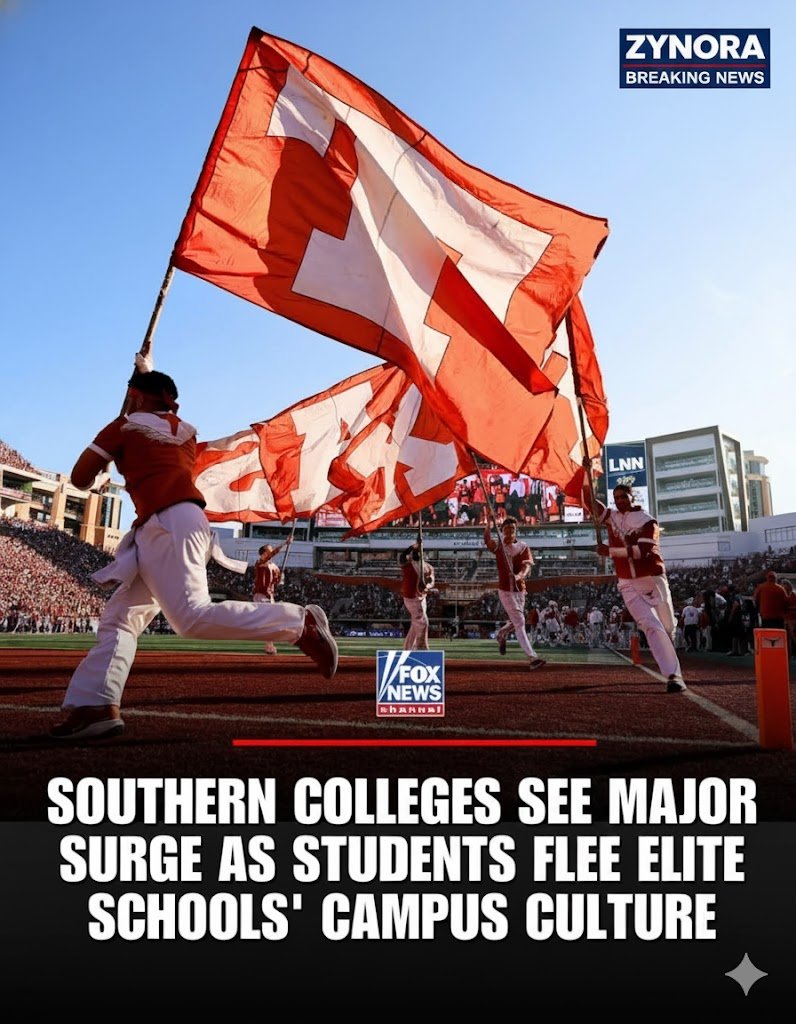
THE GREAT EXODUS: Why America’s Elite Campuses Are BLEEDING Students to the “Unwoke” South – And What It Means For The Future of Higher Ed
FOR IMMEDIATE RELEASE
Nashville, TN – A seismic shift is rocking the foundations of American higher education, and the tremors are being felt from the ivy-clad halls of the Northeast to the sun-drenched campuses of the South. A groundbreaking analysis reveals a staggering exodus: students from traditionally liberal Northeastern states are abandoning their prestigious, “elite” institutions in droves, flocking instead to Southern universities once dismissed as mere football factories. The numbers don’t lie: between 2014 and 2023, SEC schools alone witnessed a mind-boggling 91% surge in undergraduate enrollment from the Northeast. This isn’t just a trend; it’s a full-blown cultural migration, sending shockwaves through faculty lounges and parent groups alike.
What in the name of academic freedom is going on?
The Allure of the “Old School” Experience: Sunshine, Saturdays, and Sanity?
For years, the narrative was clear: the pinnacle of intellectual pursuit lay in the venerable institutions of New England and the Mid-Atlantic. But a new generation of students, armed with skepticism and a yearning for something different, is rewriting that script. They’re trading snowdrifts for sunshine, campus protests for raucous Saturday football games, and what many perceive as a stifling, dogmatic campus culture for one defined by community, tradition, and perhaps, a dose of common sense.
“It felt like walking on eggshells all the time,” confides Sarah Chen, a former New York high school student now thriving at the University of Alabama. “Every conversation was scrutinized. Every opinion had to align with a very specific viewpoint, or you were ‘problematic.’ Here, people still debate, sure, but there’s a lightness, a genuine warmth. We actually enjoy being students.”
This sentiment is echoed by countless others. The “Southern college experience,” long caricatured as merely a party haven, is being re-evaluated as a sanctuary from what critics label as the “woke industrial complex” of elite Northern schools. Students are gravitating towards campuses where Greek life thrives unencumbered, where school spirit isn’t seen as a vestige of a bygone era, and where, crucially, they feel they can express themselves without fear of immediate cancellation.
Beyond the Headlines: The Economic and Ideological Divide
While the allure of “sunshine, football, and Greek life” is undeniably potent, deeper currents are driving this migration. The spiraling cost of tuition at elite Northeastern institutions, coupled with a perceived decline in tangible value for money, is a major factor. Southern public universities, often bolstered by generous state funding, are offering compelling merit scholarships that make them financially irresistible, even for out-of-state students.
“My son got into several top-tier schools up North, but the sticker price was astronomical,” explains Mark Thompson, a father from Massachusetts whose son chose Clemson over an Ivy League offer. “Then Clemson offered him a nearly full ride. When we visited, we saw happy kids, engaged professors, and a real sense of community. The choice wasn’t just financial; it was about where he’d truly thrive, not just survive.”
But it’s not just about dollars and cents. An ideological chasm is widening. Parents and students alike are increasingly vocal about what they describe as an overwhelming focus on identity politics, safe spaces, and grievance studies at the expense of robust intellectual debate and a commitment to viewpoint diversity in certain “elite” institutions. The South, by contrast, is perceived by many as offering a more balanced, or at least less overtly progressive, academic and social environment.
“It feels like the North has gone too far left, and students are looking for a swing back to the center,” observes Dr. Alistair Finch, a sociologist specializing in generational trends. “They want to be educated, not indoctrinated. They want to explore ideas, not be told what to think. And the South, whether intentionally or not, is currently fulfilling that need for a significant portion of the student population.”
The Looming Implications: What Happens When the North Loses Its Edge?
This unprecedented shift raises critical questions for the future of American higher education. Will Northern universities be forced to re-evaluate their campus cultures, their curricula, and their financial models to remain competitive? Or will they double down, creating an even starker ideological divide between regions?
The “brain drain” once associated with the South is now being reversed. The influx of bright, ambitious students from the Northeast is injecting new energy, new perspectives, and significant tuition revenue into Southern economies and academic programs. This could propel Southern universities to even greater national prominence, challenging the long-held dominance of their Northeastern counterparts.
Conversely, what happens to the intellectual vibrancy and diversity of Northern institutions if a significant segment of their traditional applicant pool opts out? Could they become increasingly insular, catering to an ever-narrower ideological demographic, potentially alienating a broader swath of American society?
This is more than just a geographic relocation of students; it’s a referendum on the very purpose and promise of higher education in America. As the lines blur and the traditional pecking order is disrupted, one thing is clear: the South is rising, not just economically, but culturally and academically. And the rest of the nation – especially those “elite” schools scrambling to understand what they’ve lost – is watching with bated breath.
The Great Exodus is underway. Will the North adapt, or will it be left behind in the sun-drenched dust of a changing America? Share your thoughts below – this conversation is just beginning!