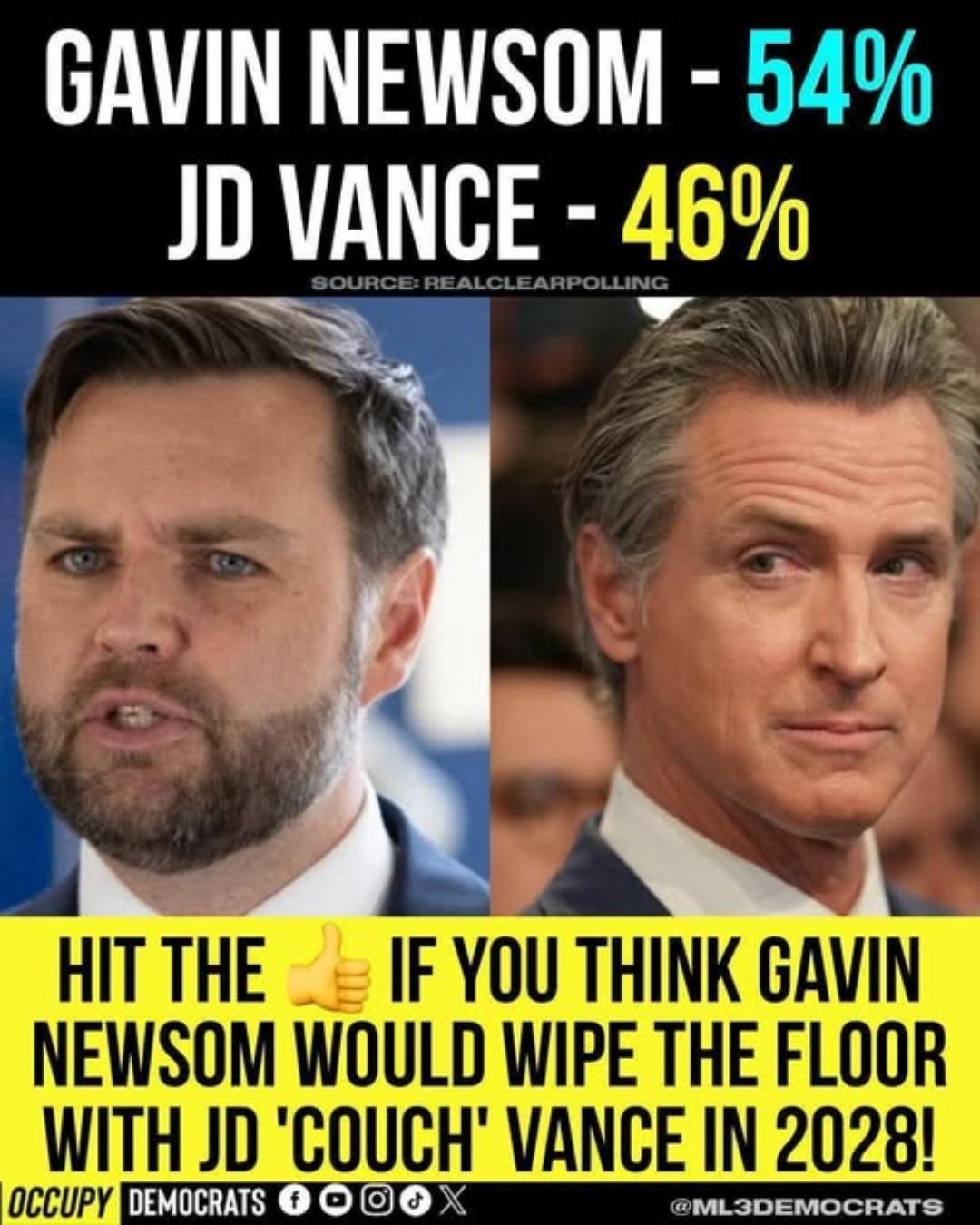
The moment the new poll graphic hit the internet—Gavin Newsom at 54%, JD Vance at 46%—it felt like someone had thrown a lit match into a room already soaked with gasoline. Within minutes, screenshots were everywhere: Instagram stories, Twitter timelines, TikTok stitches, political forums, group chats, and cable news chyrons that flashed in red and yellow like emergency sirens. It didn’t matter that the election was still years away. It didn’t matter that polls shift like weather patterns in a storm. What mattered was the narrative—and tonight, that narrative had violently slammed itself into the national bloodstream.
People did not simply see the numbers—they reacted to them. It was primal. Emotional. Predictable in some ways, but explosive in others. Those who admired Newsom felt a surge of confidence they hadn’t dared express out loud. Those who supported JD Vance felt their stomachs clench, already preparing counterarguments. And those who were exhausted by politics altogether felt another wave of dread roll over them, the familiar tightening in their chest that signaled another political cycle forming on the horizon.
But beneath the noise, beneath the jokes and cheers and anguish, there was something else simmering—an unspoken acknowledgment that this poll, fictional or not, captured a broader cultural vibration. A shift. A warning. Or perhaps a prophecy.
The story truly began, however, not with the poll, but with the reactions to it. Reactions reveal more than numbers ever can.
In one corner of the internet, a wave of confidence poured out from accounts who had spent the last few years watching Gavin Newsom rise from California’s sharply scrutinized governor to a polished national figure. They celebrated the poll not as a statistical snapshot but as a symbol of momentum. Some called him the “inevitable nominee.” Others described him as “the only one with the charisma to match the moment.” And someone somewhere coined a phrase that quickly began trending: “Newsom Nation Rising.”
In another corner, JD Vance supporters fired back with equal intensity. They dismissed the numbers as skewed. They mocked the pollster. They insisted the silent majority was still with them. And a few accounts—anonymous but loud—circulated their own “counter-graphics,” each one more dramatic than the last. In their universe, Vance was not trailing—he was climbing. He was awakening. He was “the next great contrast candidate,” a phrase that itself began trending among those who believed the culture war was entering its sharpest phase yet.
Political analysts jumped into the fray next. Some attempted to dissect the numbers methodically, offering decades of experience as if experience still held weight in an era where every opinion was instantly equaled by ten thousand others. Others, perhaps more honestly, simply threw their hands up and declared that polls this early meant nothing, that the real battle wouldn’t begin until debates, scandals, endorsements, betrayals, and unpredictable currents reshaped the landscape.
But the narrative refused to loosen its grip.
Cable news opened emergency roundtables. Pundits scrambled to rewrite their scripts. The poll didn’t just spark a conversation—it devoured everything else in its path. And soon enough, the noise reached the people on the graphic themselves.
Gavin Newsom saw the numbers while stepping off a conference stage in Chicago. An aide shoved the phone into his hand with a half-worried, half-awed expression. Newsom looked at it for a long moment—not smiling, not frowning, simply absorbing the weight. He knew better than anyone what numbers could mean. He also knew what they didn’t. But the key wasn’t the poll itself—it was what people interpreted from it. And in politics, interpretation is more powerful than truth.
JD Vance saw the graphic in a quieter setting, seated in a dimly lit study where the only sound was the low hum of the air conditioning. His reaction was shorter but far more visible: a tight jaw, a slow inhale, a single nod. He was not a man easily shaken—not publicly, not privately. But even he could not pretend the poll didn’t sting. It wasn’t about the gap. Politicians rise and fall in polls like tides. It was about perception. About the message being sent by every retweet, every comment, every emoji reaction.
The message was clear:
The country is choosing sides already.
Meanwhile, strategists behind the scenes felt their blood pressure spike. They held frantic calls, late-night huddles, whispered debates behind closed doors. They knew something the public often forgot: early polls can shape donor behavior, volunteer enthusiasm, media coverage, platform development, even debate prep. And like a chemical chain reaction, once those elements shift, the entire political ecosystem begins to mutate.
But this story wasn’t really about strategy either. It was about something deeper—a cultural divide disguised as a poll.
To some, Newsom embodied a future built on polished liberal optimism, sophisticated media presence, smooth rhetoric, and technocratic solutions. To others, Vance represented a rebellion against political convention—sharp, unfiltered, rooted in a defiant Appalachian narrative that resonated far beyond his biography. The poll was not simply measuring preference; it was measuring two different visions of America, clashing long before the first campaign ad would ever hit the airwaves.
Online, the conversations grew louder.
Some joked:
“54–46? Looks like JD ‘Couch’ Vance might need to stand up.”
Others retorted:
“Polls don’t vote. People do.”
A few simply asked:
“What happens next?”
And that question—simple, uneasy, honest—hung over everything.
Because beneath the memes, beneath the shouting, beneath the bravado, there was a quiet awareness that the country stood on the edge of something large, something complicated, something fragile.
The poll image, with its bold colors and sharp contrast, became a digital symbol of a political storm assembling itself piece by piece across the national sky. It didn’t predict the future. It didn’t decide the race. But it revealed something real:
America was preparing for its next collision.
Gavin Newsom knew it.
JD Vance felt it.
The country sensed it.
And the internet amplified it.
In the end, the poll was not a measurement.
It was a spark.
And the fire it ignited would burn all the way to 2028.